
Treatment Options and Outcomes
There are currently 3 treatments available in Australia and 2 in NZ. Your team will help guide you on which is best for your child.
No evidence says one is better or worse. They all work best when given early, have their own risks and benefits, and all are subsidised by the government at minimal cost for families (for almost everyone). The main differences are how they are given, how often they are given, and what exactly they do to help.
There are different reasons families and their healthcare teams choose one treatments over others. Your healthcare team will talk to you and help you make the right choice for you and your baby.
Here are some common questions families have about treatments. This may help you start thinking about the treatment options.
What treatments are there for SMA?
There are three treatments for SMA. Here, we use the names of the treatments most often used in Australia and New Zealand.
- Spinraza (nusinersen)
- Zolgensma (onasmenogene aberparvoec-xioi)
- Evrysdi (risdiplam)
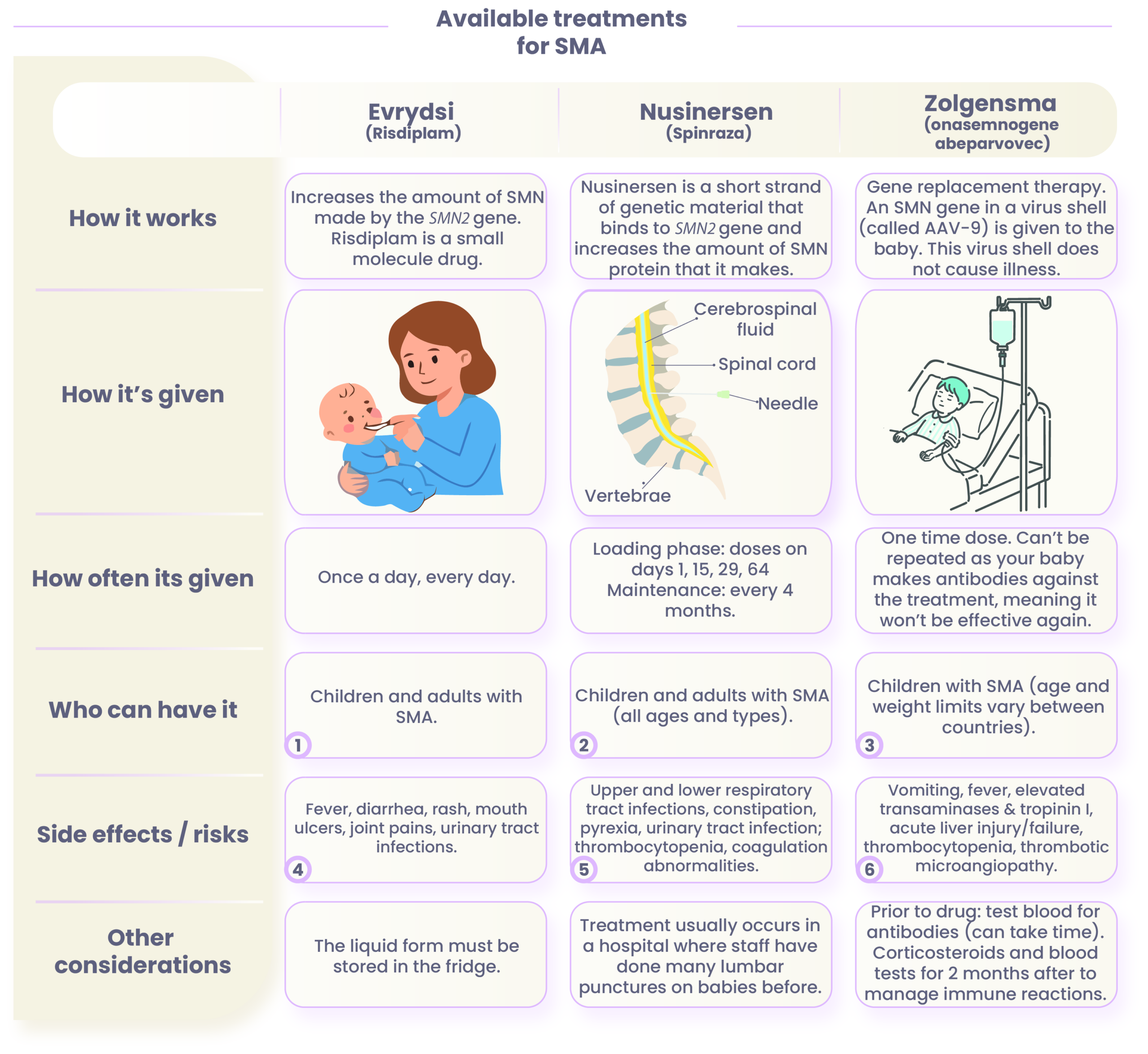
These treatments differ by the way they work, the way they are given, and how often they are given.
These treatments all work by increasing the level of SMN, or survival motor neuron protein (low levels of this protein cause SMA).
All three treatments target the motor neurons in the spinal cord. Some treatments also reach other cells around the body. The long terms benefits and risks of this are unknown.
All three treatments have been shown to work and there is no comparison that shows one is better than the other.
Since we know all three treatments work best if given early, your healthcare team will work hard to prevent delays to treatment.
None of the treatments are cures.
These treatments are known as ‘disease modifying therapies’.
This means they can be lifesaving and allow progress or stability in movement, breathing and feeding. Outcomes vary and your healthcare team will be able to talk to you.
As a general rule, access to treatments in Australia is currently for:
- Newborns and children who do not have signs and symptoms of SMA and have ≤3 copies of the SMN2 gene.
- All newborns and children with signs and symptoms of SMA.
Access to treatments in New Zealand is currently for:
- Newborns and children who do not have signs and symptoms of SMA and have ≤3 copies of the SMN2 gene.
- All newborns and children with signs and symptoms of SMA, provided they have onset of symptoms less than 4 years of age.
There are some limits in access to the treatments. You can find out more about those by clicking ‘here’, or by asking your healthcare team.
Do I have to pay for treatment? In Australia, treatments are covered by the Pharmaceutical Benefits Scheme (PBS). In New Zealand, treatments are covered by the PHARMAC. This means that if your baby is eligible, you will not need to pay.
Your healthcare team will talk to you about tests that they may want to do before they treat your baby. These can include blood tests to make sure their blood count, kidney and liver tests are normal. They may want to make sure the kidneys are healthy by taking a urine sample for testing. More tests might be needed based on which treatment you choose.
- Risdiplam (Evrysdi)
- Nusinersen (Spinraza)
- Zolgensma (onasemnogene abeparvovec)
Evrydsi (Risdiplam)
- How does the treatment work:
Increases the amount of SMN made by the SMN2 gene. Risdiplam is a small molecule drug. - How do we give my baby the treatment
A liquid for babies taken by mouth. - How often do we give the treatment
Once a day, every day. - Who can access this treatment
Link? - What are the potential side effects and risks
Link? - Special considerations:
The liquid form must be stored in the fridge
Nusinersen (Spinraza)
- How does the treatment work:
Nusinersen is a short strand of genetic material that binds to SMN2 gene and increases the amount of SMN protein that it makes. - How do we give my baby the treatment
Nusinersen is given into the space around the spinal cord that is filled with a fluid called cerebrospinal fluid. To get the medication in, your baby will have a small needle introduced into the back, between the bones of the spine (vertebrae). This is called a lumbar puncture. - How often do we give the treatment?
Once every two weeks for the first three doses . This is called the loading phase.
Then there is a gap of a month before the 4th dose is given.
Maintenance doses are given every 4 months for life.
Treatment usually occurs in a hospital where staff have done many lumbar punctures on babies before.
Who can access this treatment
Link? - What are the potential side effects and risks
Link? - Special considerations:
Zolgensma (onasemnogene abeparvovec)
- How does the treatment work?
Zolgensma is a gene replacement therapy. An SMN gene is put into the shell of a virus called adeno-associated virus 9 (AAV-9) and then given to the baby. This virus shell does not cause illness. - How do we give my baby the treatment
Zolgensma is given into the blood stream (intravenously) through a small tube that sits in your baby’s vein (cannula). The treatment is given over 60 minutes. - How often do we give the treatment?
This is a single dose given once in a lifetime. The dose cannot be repeated as your baby will make antibodies against the treatment, meaning it won’t be effective a second time. - Who can access this treatment
Link? - What are the potential side effects and risks
Link? - Special considerations:
Before giving, we need to make sure your baby has not developed proteins (antibodies) to the viral shell that houses the SMN1 gene (AAV-9 antibodies). We test your baby’s blood for the level of antibodies. The results can take time.
Corticosteroids are given and blood tests are done for approximately 2 months following Zolgensma to manage immune reactions that can cause liver of clotting issues.
In Australia and New Zealand, babies who do not have signs of SMA and with 4 SMN2 copies cannot access treatment immediately.
It is very important that they have regular checks by the healthcare team. This is because we need to look for the earliest signs of SMA, so that these children can access treatment as soon as possible. Your healthcare team will tell you how often your baby needs to be reviewed.
Outcomes
Your HCP team will talk with you about expectations for your baby.
For children with 2 copies of SMN2 that are NOT treated, muscle weakness and floppiness appear before the age of 6 months. Children lose strength and do not learn to sit or walk and only 10% live until the age of 2 years.
Babies treated quickly and with no symptoms can have development that is similar to children without SMA or slight motor delay. Follow up for about 8 years shows that children may have differences in walking for long distances, running and climbing stairs.
How can I help my baby have the best outcomes?
We know that children who are treated quickly have better outcomes, and your healthcare team will work quickly so that your baby can be treated without delay.
We also know that babies who have the care of a team of people (multidisciplinary team) both in their local communities and in specialist teams have better outcomes. We want babies to thrive and that means they need the care of a whole team around them.
To find out more about who the team is, click here.
From a parent
“We wanted to have treatment, take on all of the information and get as many opinions as possible, but at the same time we knew that we had to move quickly. Talk to your healthcare team so that you can understand what is going on and all of your options. In the end you have to do what feels right and is the best decision for your child. We made the best call with the information we had available and that is what you can do”